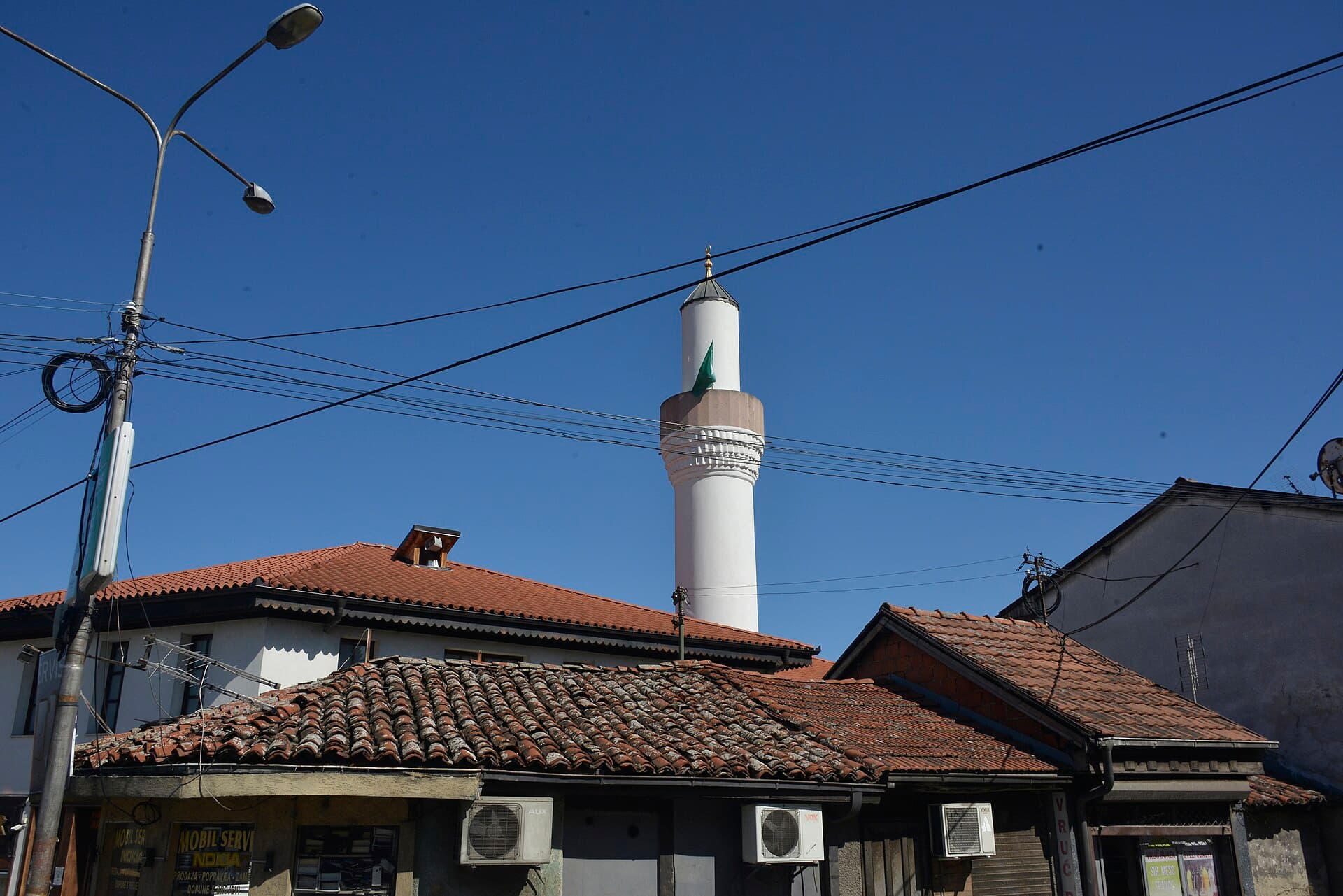
Hasan Čelebi's mosque and a man called Arap
The mosque first appears in a register of 1528. Sixteenth-century sources name the builder as Hasan Čelebi, or Hasan-beg, after whom it was originally called; nothing reliable is known about his background.
In 1689 the mosque was burned — the same year Sopoćani was — and afterwards rebuilt. Tradition holds that a man known as Arap repaired it, by some accounts an officer or official serving in Pazar, and that it carried his name from then on. His grave, the same tradition says, lies in the Great Cemetery and is still spoken of as Arap's.
The minaret over the bazaar
The mosque stood at the very entrance to the old bazaar, ringed by craft and trade shops attached to it in an unusual way. Its minaret — circular in section, built of brick with a stone facing — was regarded as the visual accent of the whole bazaar: stocky and archaic, an example of local expression in sacred building.
What happened in 2018
In April 2018 the Islamic Community in Serbia removed the mosque's roof, intending to restore it. On 31 May 2018 the Republic Institute for the Protection of Cultural Monuments issued a decision forbidding work on the roof structure until a permit to carry out works had been obtained. According to the City's statement, no such document was ever submitted and the works were not halted.
Roofless, the walls began to give way over the summer. On 18 September 2018 the mosque was demolished with heavy machinery — everything but the minaret. The city commission judged that instead of expert restoration there had been crude demolition, "without any regard for tradition and its symbolism", and that a mosque which had stood for centuries no longer existed. The Institute then also forbade the demolition of the remaining walls and the minaret.
What stands there now
A new building has been raised on the site of the old mosque. It is worth seeing as part of the bazaar, but worth knowing what you are looking at: this is not a 16th-century monument. The case has been cited in reporting on the wider loss of Ottoman heritage in Sandžak.