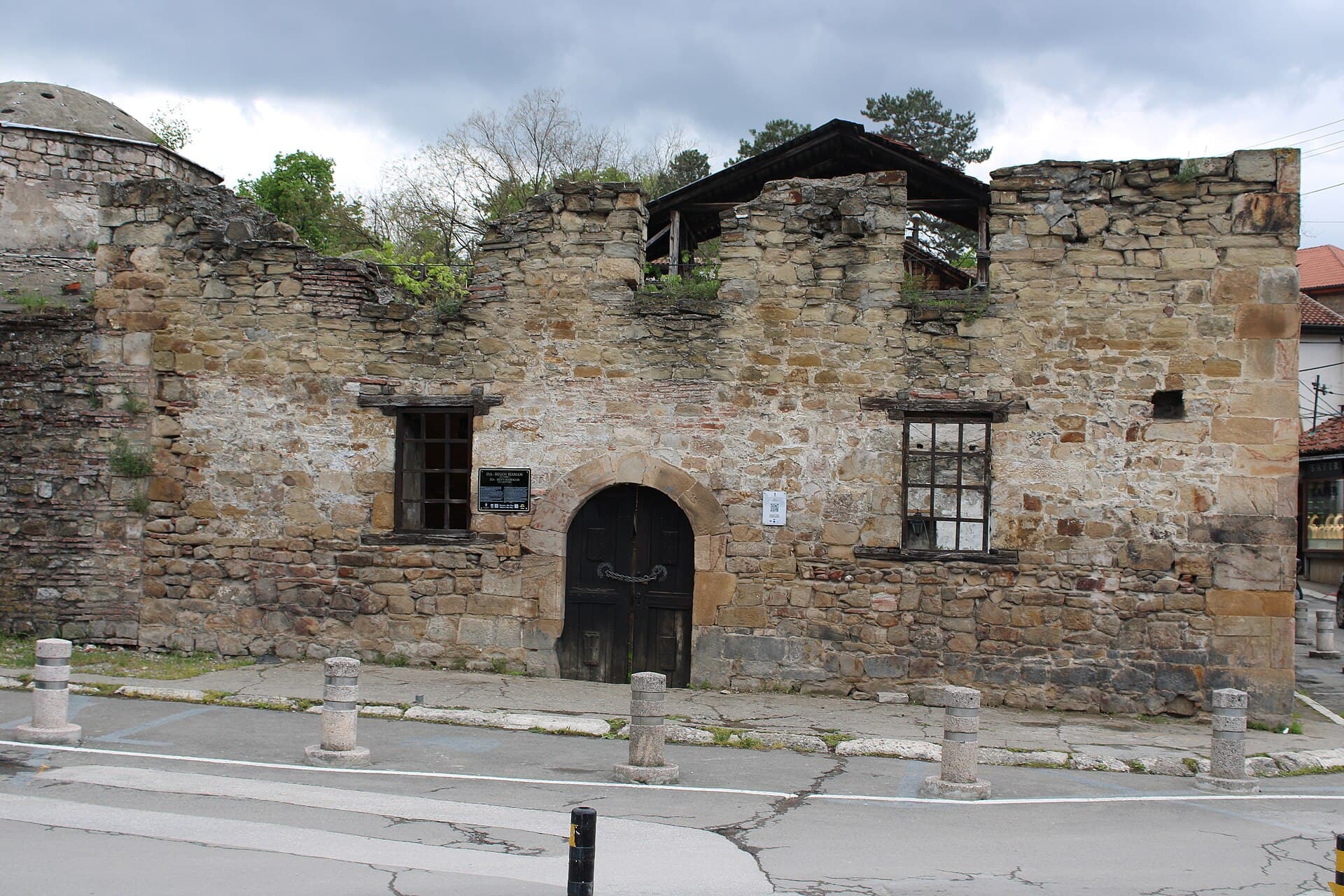
A bath built with the city
When Isa-beg Ishaković founded Novi Pazar in 1461, he endowed it with a mosque, a marketplace and a hammam — the public bath without which an Ottoman town was unthinkable. It was built in the second half of the 15th century and appears in written sources in 1489.
The building measures 23 by 26 metres and belongs to the double hammams — separate men's and women's halves under one roof. Its size and age place it among the most significant monuments of its kind in the country.
How the hammam was arranged
Eleven domes of different sizes cover the building. The northern side holds a spacious fountain hall that served as the waiting room; on the southern side are the hazna where the water was heated, three bathing rooms with marble basins, and rooms for resting afterwards. The men's and women's halves are identical, divided by a stone wall.
The building stands in the Old Bazaar on the Istanbul Road — part of the trade route that ran from the Republic of Dubrovnik to Istanbul in the 16th and 17th centuries. Ottoman and French travel writers record that wealthier families went to the hammam and attached great importance to doing so.
Conservation
The Institute for the Protection of Cultural Monuments in Kraljevo carried out restoration and conservation work from 1969 to 1975, which saved the building from decay.